Romain Bernini
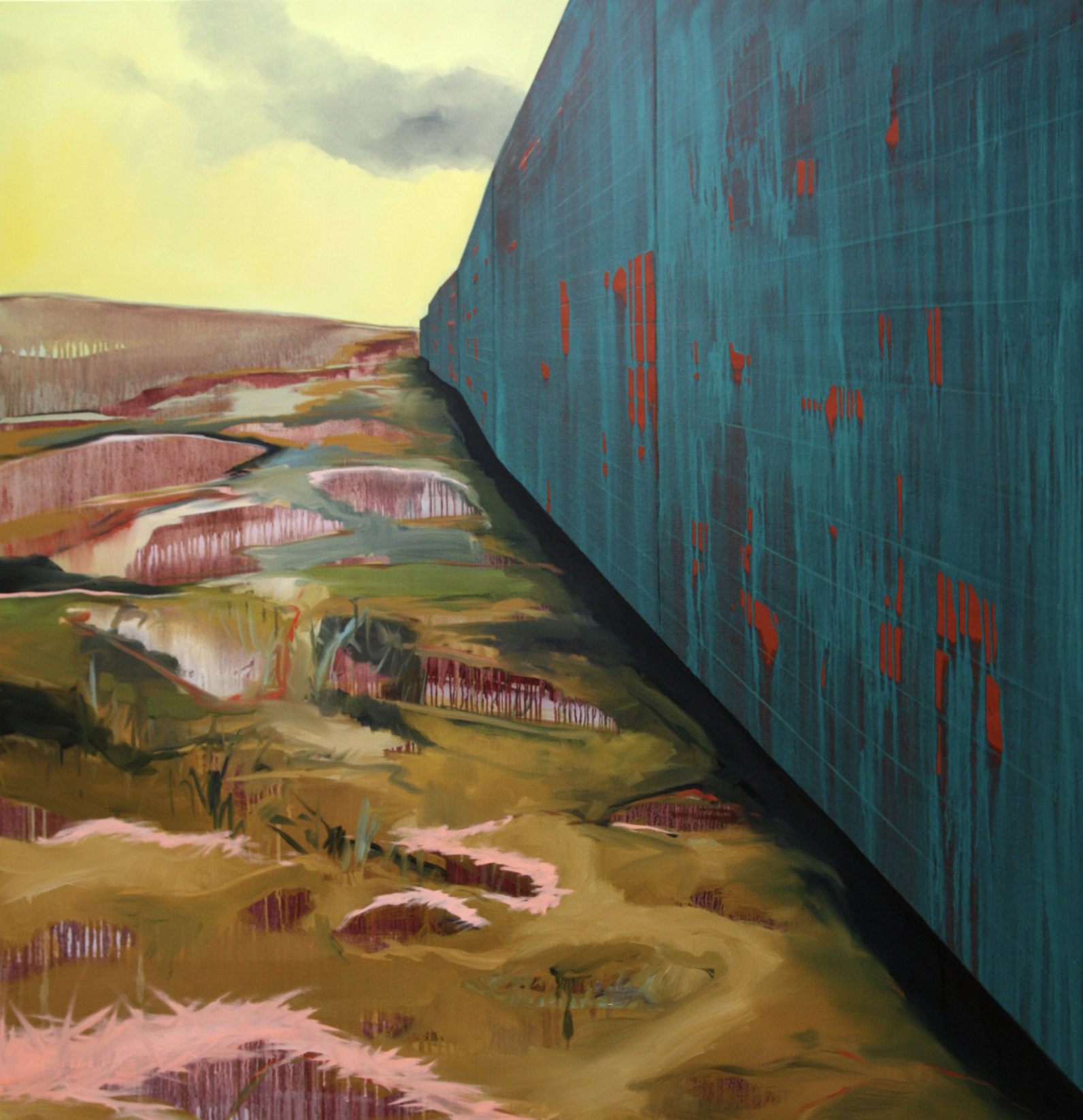
The core of the work of the French artist Romain Bernini (*1979) lies in the medium of painting. In his paintings, he develops a distinctive visual language grounded in a tension between figuration and its destabilization: realistically defined figures, animals, or objects appear within environments that lack a fixed spatial logic. The places inhabited by these figures or objects thus function more as atmospheres than as concrete locations. He proceeds in a similar manner even in the relatively few instances where landscape constitutes the primary subject of his work. Although such landscapes may appear more anchored, they too occupy a space shaped by a specific imaginative atmosphere that sets the tone of the entire scene much like background music. Characteristic is his use of intense, at times almost “toxic” color and of flatness, which weakens the illusionistic depth of the image and emphasizes its optical, and above all its mental, dimension.
Recurring motifs in Bernini’s work include landscapes, ritual figures, animals, and situations situated at the threshold between the present and an indeterminate, often unidentifiable time. His paintings bring together references to popular culture, anthropology, and non-Western visual traditions, without anchoring them in any specific location or cultural framework. This tension between incommensurable visual and cultural systems produces situations that may be understood as images of a world stripped of clear hierarchies and stable meanings. Bernini’s painting does not create a representation of reality, but rather its unsettling analogue, in which the boundaries between human, animal, and environment are blurred and the relationships between them are reconfigured.
Romain Bernini was born in France, where he lives and works in Paris. In 2010–2011 he was a resident at the Villa Medici in Rome. He is represented by the galleries Suzanne Tarasieve (Paris) and HdM (London, Beijing). His work has been presented in a number of institutions in France and abroad, including MO.CO in Montpellier, MUba Eugène Leroy in Tourcoing, Tripostal in Lille, and the Collège des Bernardins in Paris, as well as K11 in Wuhan, Daegu Art Factory, and the Wooyang Museum of Contemporary Art in South Korea. His works are included in major public collections, including the Centre Pompidou, the Centre national des arts plastiques, MAC VAL, the Musée des Abattoirs in Toulouse, and the FRAC Île-de-France. In 2023, he began teaching at the École nationale supérieure des Beaux-Arts in Paris.