Suzanne Treister
At the beginning of her career, she was primarily associated with painting; however, since the 1990s, the British intermedia artist Suzanne Treister (*1958) has been among the pioneers of new media and web-based art. Her work consistently brings together the practice of a visual artist with a research-oriented approach, within which she develops complex narrative frameworks exploring the relationships between technology, power, knowledge, and systems of belief. She is characterized by large-scale projects that, through fictional archives, taxonomies, and alternative histories, reveal hidden or difficult-to-grasp forces shaping the contemporary world, whether institutional, corporate, military, spiritual, or esoteric.
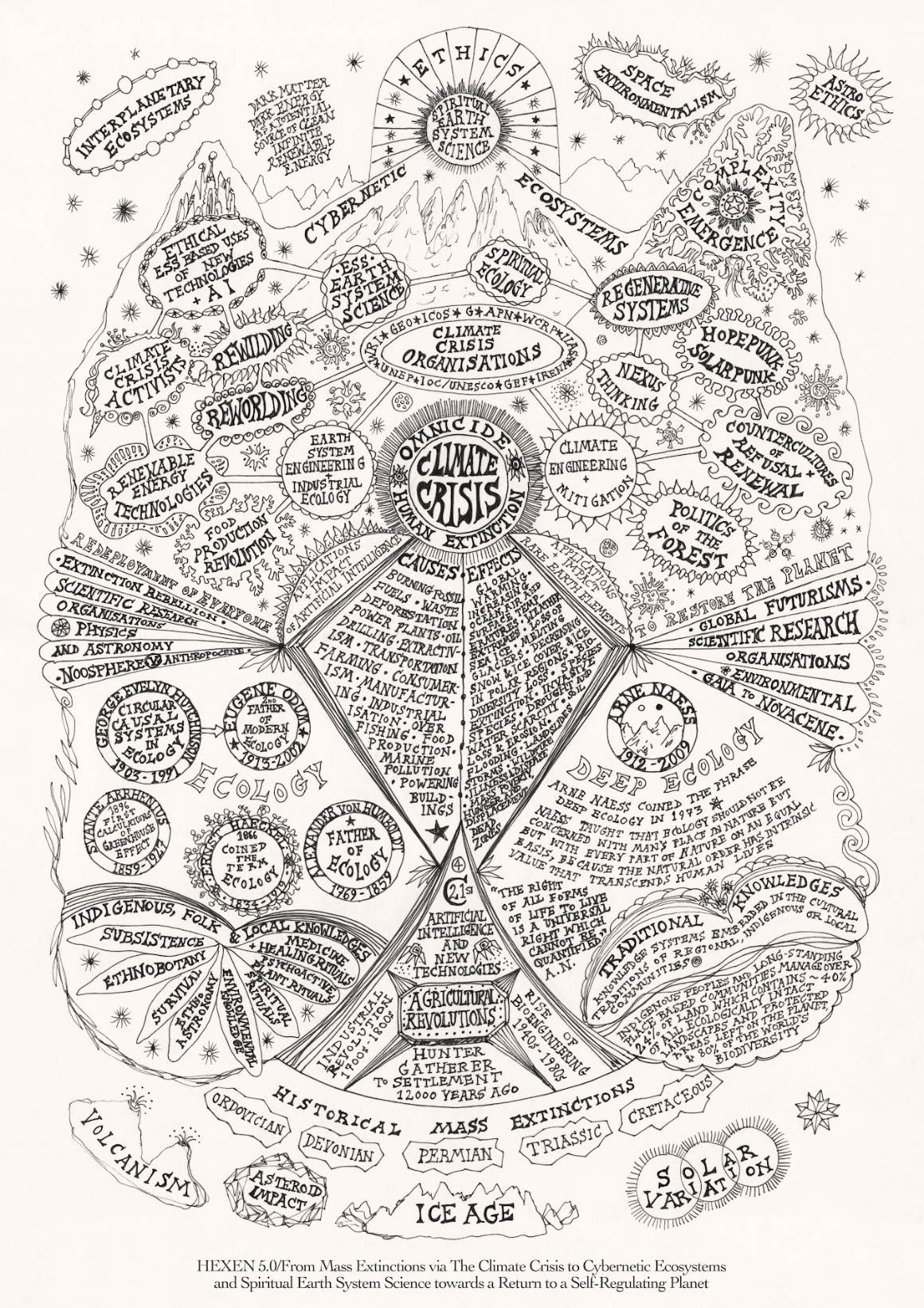
Her projects bring together references to cybernetics, psychedelic culture, occultism, and geo politics. A recurring strategy in her work is the reinterpretation of existing classificatory frameworks – whether historical, scientific, or religious – and their repositioning within new, often paradoxical configurations. These research structures are subsequently translated into specific visual forms: diagrams, maps, series of watercolors, cards, or archive-like assemblages that evoke scientific or esoteric systems of knowledge. Individual works thus often function as components of broader, systematically constructed wholes, in which the aesthetics of data, symbol, and speculative fiction intersect.
Suzanne Treister studied at St Martin’s School of Art and Chelsea College of Art and Design, and lives and works in London. Her work has been presented in a number of major institutions, including Tate Modern in London, Centre Pompidou-Metz, Thyssen-Bornemisza Art Contemporary, and Modern Art Oxford. She is represented in public collections including Tate Britain, the Centre Pompidou, the Science Museum in London, and Muzeum Sztuki in Łódź. In addition to gallery and institutional presentations, her work is also included in a number of new media art archives and academic collections