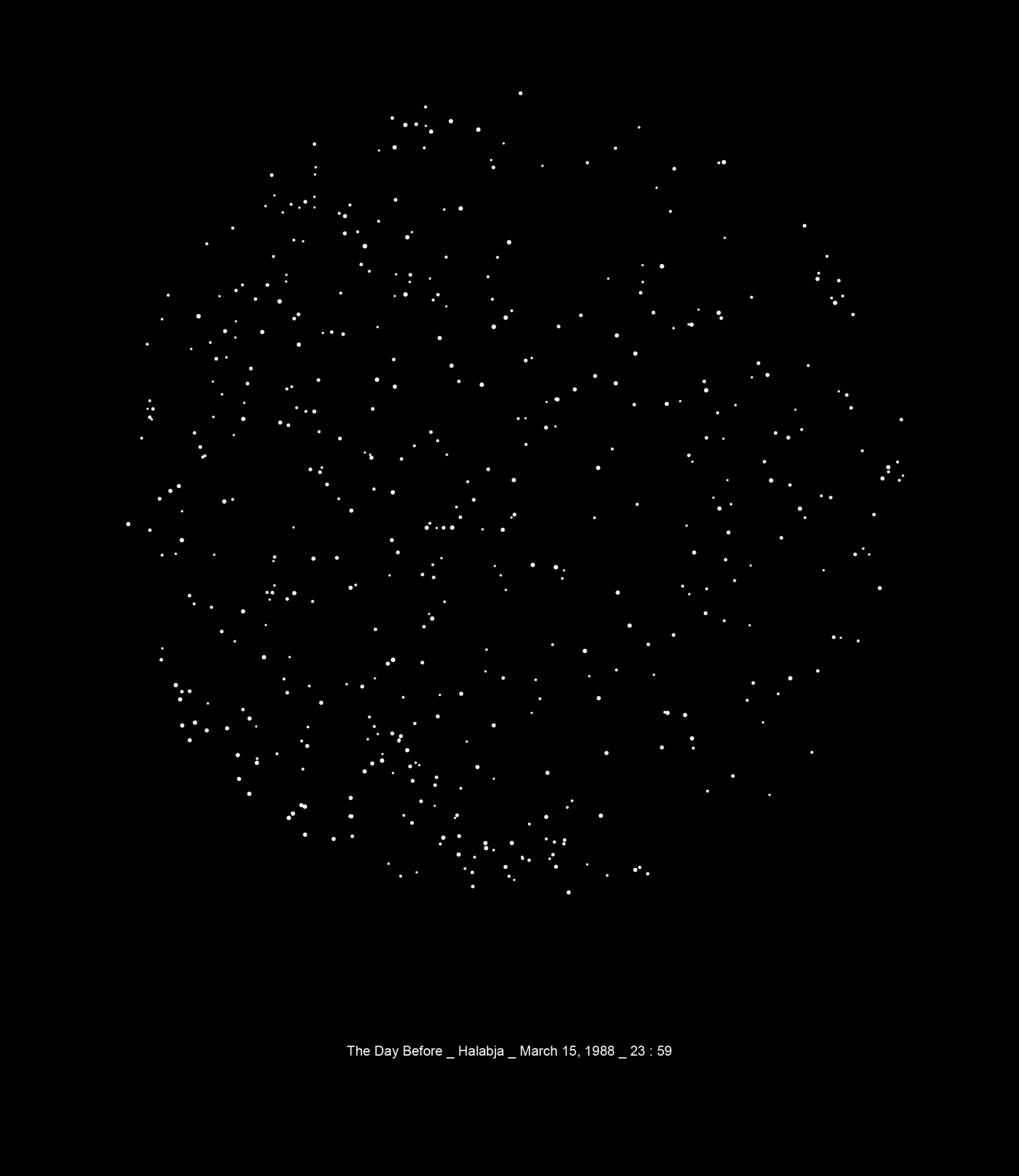
Renaud Auguste-Dormeuil
Renaud Auguste-Dormeuil (*1968) is a French visual artist who, since the mid-1990s, has systematically examined the conditions of the production, circulation, and instrumentalization of images within political and media contexts. Through meticulously constructed installations, photographs or tapestries, he investigates the mechanisms that shape collective memory and influence our understanding of both historical and contemporary reality.
A central motif of his work is the tension between the visible and the concealed. Auguste-Dormeuil repeatedly returns to the “moment before the event,” the instant just prior to a conflict, catastrophe, or geopolitical rupture. In projects employing archival materials, maps, or reconstructions of the night sky preceding a specific traumatic event, he points to how easily our perception of the past can be shaped and manipulated. He challenges the notion of the document as neutral testimony, demonstrating that even seemingly objective records are always the result of selection, interpretation, and context. By shifting perspective in this way, he disrupts linear narratives of history and reveals the fragile boundary between fact, interpretation, and fiction.
His visual language is marked by formal restraint and conceptual precision. The aesthetic subtlety of his works – often engaging with darkness, light, or cosmic motifs – creates a contemplative environment that nonetheless carries a strong political undertone. Here, the image is not a neutral bearer of information, but a tool of power, projection, and ideological construction.
Renaud Auguste-Dormeuil lives and works in Paris. He is a recipient of the Prix HSBC pour la Photographie and the Prix Meurice pour l’art contemporain. His work has been presented at institutions such as the Palais de Tokyo, Centre Pompidou, MAC VAL, and the Swiss Institute in New York, and is held in major public collections, including the Centre Pompidou and the Fonds national d’art contemporain (CNAP).