Patrick Van Caeckenbergh
The work of the Belgian artist Patrick Van Caeckenbergh (*1960) can be understood as a sustained attempt to comprehend the world through the collection, classification, and reorganization of images, information, and fragments of knowledge into new constellations. At the center of his thinking are classificatory systems such as taxonomies, genealogies, and cosmologies, which he employs not only as tools of knowledge, but also as a means of questioning them. His individual projects take the form of complex associative wholes resembling encyclopedias, museum collections, archives, or cabinets of curiosities.
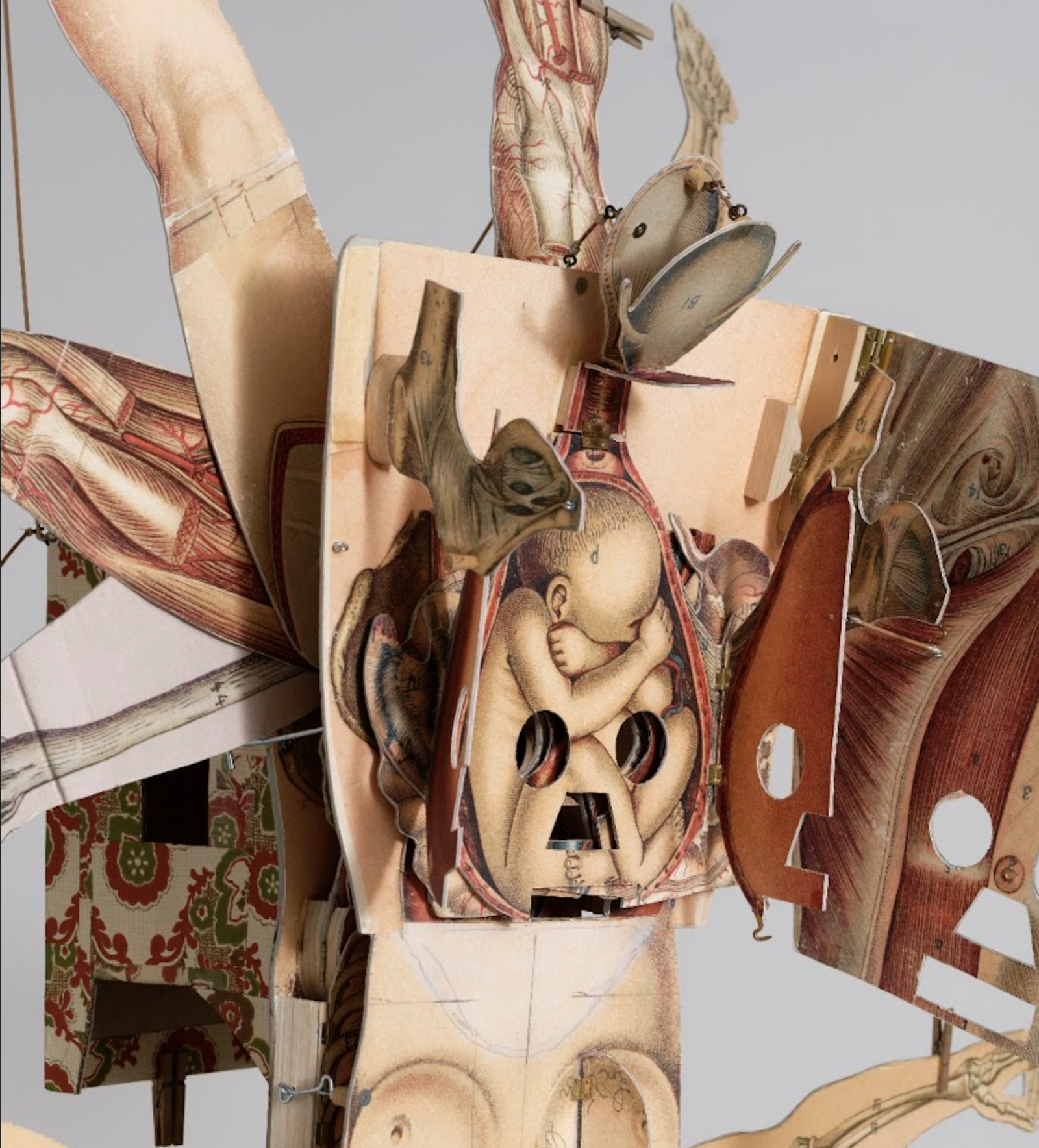
Van Caeckenbergh combines methodological precision with imaginative speculation: his drawings, although derived entirely from imagination, are rendered with such a degree of detail and systematicity that they evoke scientific illustration. This principle of “false realism” is fundamental to his practice, as it reveals how easily structure and form can produce the appearance of objective knowledge. A recurring motif in his work is the human body and the processes associated with it, particularly digestion, metabolism, and transformation, which the artist understands not only in biological terms, but also as metaphors for knowledge and the assimilation of the world. His work thus oscillates between the desire to systematize the world and the awareness that any such attempt is necessarily incomplete and conditioned. Through personal experience and biographical fragments, he constructs models that connect an individual perspective with broader cultural and epistemological frameworks.
Patrick Van Caeckenbergh was born in Aalst, Belgium, and lives and works in Sint-Kornelis-Horebeke. Since the 1980s, he has systematically developed his practice, which has been presented in a number of major European institutions, including M-Museum in Leuven, Musée Gassendi in Digne-les-Bains, La Maison Rouge in Paris, and the Bonnefantenmuseum in Maastricht. He has participated in international exhibitions including the 55th Venice Biennale (Il Palazzo Enciclopedico, 2013) and the Taipei Biennial (The Great Acceleration, 2014). His works are held in major public collections such as the Centre Pompidou in Paris, M HKA in Antwerp, S.M.A.K. in Ghent, and the Middelheim Museum in Antwerp.